



23 September 2026
by Beutel Goodman Fixed Income Team
The term hyperscaler is somewhat ambiguous but generally refers to a large organization offering computer systems and data storage on a considerable scale. At present, financial markets have placed the moniker of “hyperscaler” on five companies: Microsoft, Amazon, Alphabet (Google), Meta and Oracle, despite their vastly different alternative sources of revenue and operations (colloquially referred to as the “Big 5”). A sixth name is sometimes added to the list, SpaceX, but at least for the time being, we would be more inclined to classify their business model as “to be determined.” A lot has been made of the recent shift in hyperscaler funding profiles, so we thought it worthwhile to illuminate how they’ve been altering the financial market landscape of late, especially as it pertains to North American credit markets.
To begin with, we must examine why these so-called “hyperscalers” need such vast amounts of funding. The reason is fairly straightforward: As the use of artificial intelligence (AI) across all manner of businesses gathers steam—which it has been doing since the introduction of OpenAI’s ChatGPT in November 2022—it’s been a virtual arms race between the major players in the AI ecosystem to see who can develop the most efficient models and stay ahead of the game as the competitive landscape grows ever more challenging. This requires massive amounts of computing power and data centres, which the hyperscalers provide and are incredibly expensive to build. Until recently, hyperscalers have largely been funding these capital expenditures using their internally generated operating cash flows, but the sheer speed at which the AI industry is evolving and expanding has forced them to cover some of the buildout with external sources of funding.
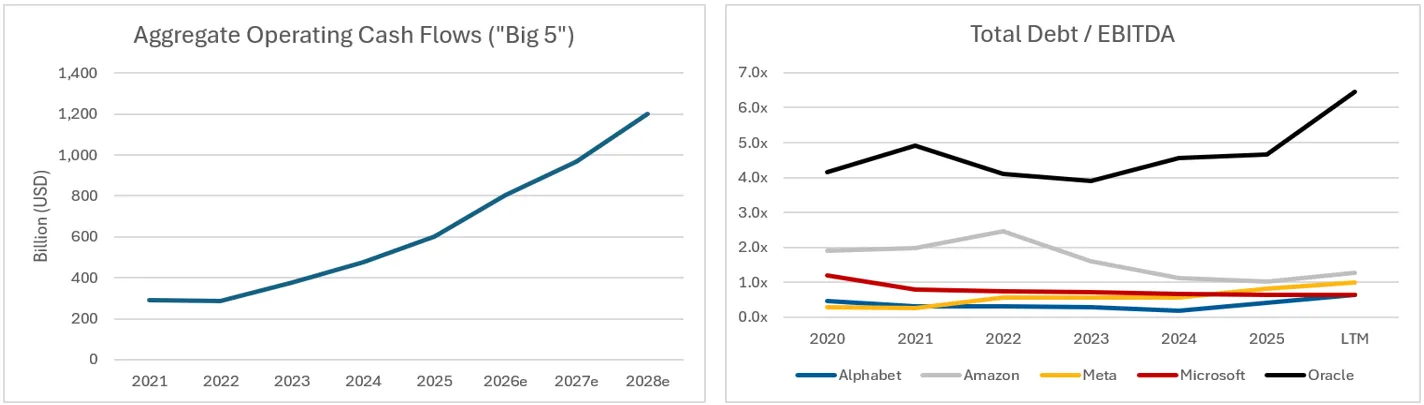
Although we’ve seen some hyperscalers issue additional equity to cover the cost of their expedited and swelling data centre construction schedules (e.g. Alphabet raising ~$85bn in June 2026), for the most part, they’ve chosen to bridge their operating cash flow to capex gaps using the public debt markets. With the exception of Oracle, whose balance sheet has now been stretched to the point of a potential ratings downgrade to ‘high yield,’ this makes perfect sense for the time being; the remaining hyperscalers are generally under-levered and have significant capacity to add debt within their capital structures, while still generating a substantial amount of operating cash flows within their primary lines of business. (See Exhibit A.)
Exhibit A: Hyperscaler operating cash flow and leverage
Sources: Beutel Goodman, Bloomberg
That said, many investors are beginning to view on-balance sheet leverage metrics, or those presented by the companies themselves, as somewhat misleading. If we factor in items such as leases, purchase commitments, guarantees and certain off-balance sheet arrangements—which, in aggregate, sum to trillions of additional liabilities—the hyperscalers’ balance sheet fundamentals start to change dramatically. The uncertainty surrounding these future commitments and the ability of operating cash flows to eventually catch up is what’s causing the most concern among investors, given that it will directly impact the timing and magnitude of future funding requirements.
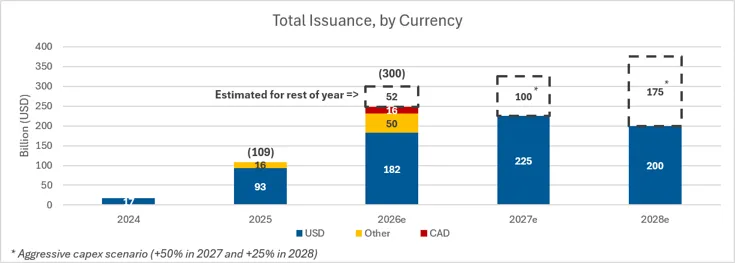
While financing could eventually migrate more towards private placements, infrastructure debt, asset-backed facilities and/or equipment financings—where collateral, contractual support and structural protections exist to protect buyers—the preponderance of debt funding so far has come in the form of public, unsecured issuance directly from the parent company. As at time of writing, if we include SpaceX, hyperscalers have combined to issue ~US$248bn-equivalent of unsecured bonds in 2026 year to date, with a further ~US$50bn expected by year end. For context, that’s nearly three times more than 2025 and dwarfs the US$17bn-equivalent issued in 2024, before AI-related spending kicked into high gear. Within the USD-denominated bond market alone, hyperscalers have issued US$182bn so far in 2026, accounting for 14% of all USD investment-grade corporate bond supply. (See Exhibit B.)
Exhibit B: Hyperscaler bond issuance
Sources: Beutel Goodman, Bloomberg, Barclays (AI Infrastructure Financing – Tracking Issuance Across Asset Classes: August 2026 Update)
Moreover, if we include data centre and neocloud bonds, chip financing and data centre securitization facilities, a total of US$338bn has been issued across the entire AI-ecosystem in 2026, as compared to US$179bn in 2025[1].
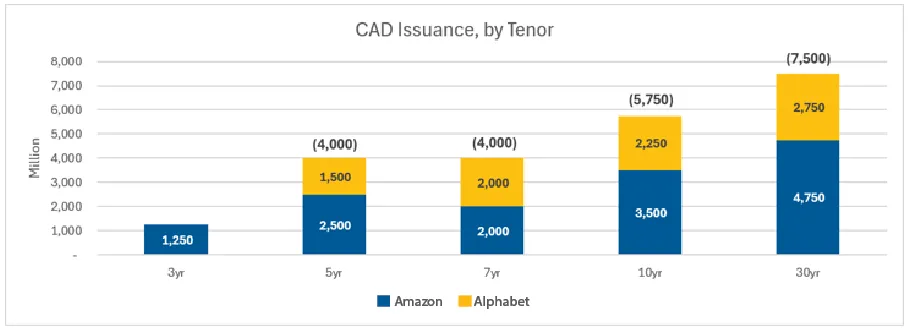
So large has their need for public debt funding been that hyperscalers have also been forced to issue bonds across a multitude of foreign currencies, including Euros, Swiss francs, British pounds and, most recently, Australian dollars. The flood of foreign currency bond issuance from hyperscalers has been so considerable that it’s shaken up many of the world’s smaller credit markets, including our own. Within Canada, Alphabet was first to market with their inaugural C$8.5bn transaction across four tranches in May, briefly giving them the title of largest bond deal ever—only to be usurped a few weeks later by Amazon, which issued C$14bn in June across five tranches. (See Exhibit C.) These two issuances alone place Amazon and Alphabet as the 9th and 18th largest corporate issuers in our market, respectively.
Exhibit C: Hyperscaler Canadian-dollar bond issuance
Sources: Beutel Goodman, Bloomberg
All things considered, the impact of all this supply on our market has been well contained thus far, with aggregate Canadian corporate bond spreads higher by just 4 basis points (bps) since Amazon’s jumbo deal (as at time of writing). Having said that, the long corporate index has widened by 10 bps over that same period, as both issuers elected to skew their issuance towards the 30-year tranche. This was somewhat unusual for a large, multi-tranche transaction in Canada, and was especially surprising given the underlying rate backdrop and the all-in yields in that part of the curve. We think this speaks to the issuers’ willingness to prioritize locking in long-term unsecured funding at scale over price.
The utility sector has also experienced atypical volatility relative to other sectors since the hyperscaler transactions. Absorbing such a large amount of bonds required many investors to sell a portion of their existing holdings in the secondary market, and utilities was the natural and easiest sector to target, given the rating similarities—most hyperscaler issuance is currently rated AA—and liquidity dynamics. At time of pricing, both Alphabet’s and Amazon’s transactions offered spread pick-ups of approximately 5 to 10 bps over utility bonds of similar tenors, as well as a steeper curve proposition, making them attractive from a relative value perspective as well.
There are benefits to having such large, liquid and highly rated (for now, at least) capital structures in the Canadian indices. Issuances of this magnitude typically come with greater liquidity, offering additional flexibility when it comes to altering aggregate, portfolio-level characteristics in a pinch, such as duration and curve positioning. They may even be used as placeholders for government bonds within more credit-oriented strategies (e.g. Core Plus, Corporate).
What does all this mean moving forward? In our opinion, hyperscaler issuance represents a long-term, structural change within credit markets. Due to their already large index weights, which are poised to grow even further, they’re nearly impossible to ignore, while their spreads have forced investors to rethink how relative value is assessed across certain sectors and curve positions. Likewise, quarterly earnings calls must be scrutinized on par with major economic data releases for cash flow and capex updates to both assess future funding needs and identify any prospective deterioration in their financial strength.
In terms of credit ratings, current fundamentals would suggest the majority of hyperscalers can continue issuing without experiencing downgrade pressure over the near term, Oracle notwithstanding. Furthermore, our base case is for the majority of hyperscalers to maintain their leverage metrics within a tolerable range—both by rating agency and investor standards—and for them to begin generating substantial free cash flow once their capital spending needs begin to wane and the benefits of their AI-related spending are realized. Of course, the backdrop remains extremely fluid in this regard, and we’re proceeding with the utmost caution as the sector evolves.
[1] Barclays (AI Infrastructure Financing – Tracking Issuance Across Asset Classes: August 2026 Update)
Download PDF
Related Topics and Links of Interest:
©2026 Beutel, Goodman & Company Ltd. Do not sell or modify this document without the prior written consent of Beutel, Goodman & Company Ltd. This commentary represents the views of Beutel, Goodman & Company Ltd. as at the date indicated. This document is not intended, and should not be relied upon, to provide legal, financial, accounting, tax, investment or other advice.
Certain portions of this report may contain forward-looking statements. Forward-looking statements include statements that are predictive in nature, that depend upon or refer to future events or conditions, or that include words such as “expects”, “anticipates”, “intends”, “plans”, “believes”, “estimates” and other similar forward-looking expressions. In addition, any statement that may be made concerning future performance, strategies or prospects, and possible future action, is also forward-looking statement. Forward-looking statements are based on current expectations and forecasts about future events and are inherently subject to, among other things, risks, uncertainties and assumptions which could cause actual events, results, performance or prospects to be incorrect or to differ materially from those expressed in, or implied by, these forward-looking statements.
These risks, uncertainties and assumptions include, but are not limited to, general economic, political and market factors, domestic and international, interest and foreign exchange rates, equity and capital markets, business competition, technological change, changes in government regulations, unexpected judicial or regulatory proceedings, and catastrophic events. This list of important factors is not exhaustive. Please consider these and other factors carefully before making any investment decisions and avoid placing undue reliance on forward-looking statements Beutel Goodman has no specific intention of updating any forward-looking statements whether as a result of new information, future events or otherwise.


