



10 November 2026
by Beutel Goodman Fixed Income Team
After more than a decade at sea, fixed income has returned to familiar waters.
For much of the period following the Global Financial Crisis, bond markets operated under unusual conditions. Policy rates remained close to zero, central banks expanded their balance sheets, and bond yields offered investors limited income. These conditions persisted for so long that they began to feel normal. In a broader historical context, however, this era of financial repression was the exception.
The tide has now turned, as bond yields have been reset higher. But what ended the old regime, and what does this new normal mean for investors?
Back to the Future
The current interest rate environment may seem extraordinary to investors accustomed to the pre-pandemic decade.
If we look further back, however, the comparison changes. Figure 1 compares key Canadian economic indicators from September 2005 and September 2026. Despite being separated by more than two decades, the two snapshots are strikingly similar.
Figure 1. Canadian macroeconomic conditions: 2005 and 2026. The table compares Canadian economic indicators as of September 30, 2005 and September 30, 2026. Inflation was 3.2% versus 3.0%, unemployment was 6.7% versus 6.4%, the Bank of Canada policy rate was 2.75% versus 2.25%, and the Canada 10-year bond yield was 3.97% versus 3.90%. The one-year change in oil prices was positive 40% in 2005 and positive 60% in 2026.
| Sept 2005 | Sept 2026 | |
| Inflation (Y/Y) | 3.2% | 3.0% |
| Unemployment Rate | 6.7% | 6.4% |
| Bank of Canada Policy Rate | 2.75% | 2.25% |
| Canada 10-year Bond Yield | 3.97% | 3.90% |
| 1 Year Price Change Oil | +40% | +60% |
Sources: Bloomberg LP. Statistics Canada
This does not mean that the underlying economic environments are equivalent. The composition of growth, fiscal backdrop, structure of global trade, household balance sheets and geopolitical conditions are different. Rather, we believe the comparison provides useful historical perspective and reinforces a central point: today’s level of interest rates is not historically unusual. Instead, it was the exceptionally low-rate period during the financial repression of 2012-2022 that was the anomaly.
This distinction is central to the outlook for fixed income. If today’s yields represent a return to more normal conditions rather than a temporary deviation, then investors may need to reconsider assumptions built during the era of near-zero rates.
The Era of Financial Repression
Why did interest rates remain so low for so long? The period preceding the Covid pandemic was characterized by a slow repair of private sector and banking system balance sheets after the Global Financial Crisis. Credit creation took a very long time to recover, weighing on business lending and housing activity. Central banks responded with near-zero policy rates and large-scale asset purchases intended to support growth and stabilize financial conditions.
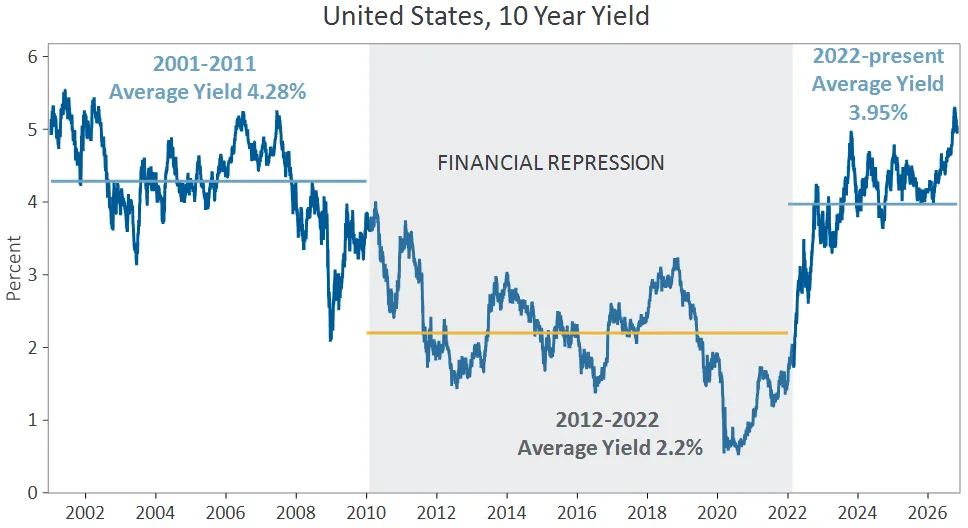
For bond investors, the consequences were clear. Government bond yields fell to unusually low levels and remained depressed through much of the 2010s. Figure 2 places this period in a longer-term historical context.
As ultra-low yields reduced the income available from high-quality fixed income, investors moved further along the risk spectrum in search of return. Many shifted their asset mix away from traditional fixed income and toward equities and alternative investments, including private market and infrastructure strategies.
Figure 2. Financial Repression and the U.S. 10-Year Treasury yield. U.S. 10-year Treasury yields averaged 4.28% from 2001 to 2009, 2.20% during the 2010 to 2021 Financial Repression period, and 3.96% from 2022 onward.
As of 2026-10-30
Sources: Beutel, Goodman & Company Ltd., U.S. Department of Treasury
The Voyage Ends
The pandemic and subsequent geopolitical conflicts disrupted the conditions that had sustained ultra-low interest rates.
Unlike the aftermath of the Global Financial Crisis, governments supported households and businesses directly during the pandemic, preventing a deleveraging cycle from occurring and preserving demand. Although consumers spent more time at home, stimulus cheques and other fiscal transfers helped sustain robust spending. Demand therefore remained unusually strong at a time when supply chains were constrained. Businesses had greater scope to pass rising costs through to customers, adding to inflation pressures and eventually inflation expectations.
Russia’s invasion of Ukraine and the resulting commodity price spikes added to these price pressures. At the same time, governments increasingly prioritized energy security, domestic production and supply chain resilience. Although these objectives may strengthen domestic economic resilience, they can also involve higher costs than a system organized primarily around global efficiency.
The fiscal response to the pandemic ushered in a period of large government deficits that has continued through the post-pandemic expansion, marking a notable departure from the more restrained fiscal environment of the prior decade.
Monetary policymakers responded to the pandemic with near-zero interest rates and large-scale quantitative easing. Inflation was initially viewed as transitory, but its persistence ultimately required the Federal Reserve and the Bank of Canada to reverse course and raise their respective policy rates by approximately five percentage points.
As monetary policy tightened, bond yields moved higher and reset to levels more consistent with the prevailing growth and inflation environment, bringing the era of financial repression to an end.
What Is Driving the Current Macro Regime?
The end of the old regime does not mean that interest rates will rise indefinitely. It does, however, suggest that yields may settle within a structurally higher range and that a return to the exceptionally low levels of the 2010s is less likely. We see several prevailing structural forces that support this view.
- Retreat from globalization: The disinflationary benefits of globalization are fading as countries prioritize security and supply chain resilience over the lowest-cost source of production. Increasing trade restrictions and tariffs are evidence of this shift.
- Demographics: Slower labour force growth constrains the supply of workers and places upward pressure on wages. At the same time, spending by an aging Baby Boomer population, specifically on health care, is likely to remain strong.
- Persistent supply shocks: Recurring disruptions related to energy, trade and geopolitics have increased the potential for sudden upward price pressures and increase in inflation uncertainty and expectations.
- AI capex boom: Significant capital spending associated with artificial intelligence including data centres, electricity grids and related infrastructure may also increase financing needs and bond issuance.
- Fiscal policy: Larger deficits and increased government borrowing may place upward pressure on real yields and term premiums, particularly at longer maturities.
- Monetary policy: Federal Reserve Chair Kevin Warsh has reduced forward guidance and shortened statements, both in length and scope. They also plan to use fewer of its scheduled meetings for regular policy decisions. These changes reduce monetary policy transparency and may increase uncertainty about the path of interest rates, contributing to greater bond market volatility and higher term premiums.
In our view, these developments point to a wider range of outcomes for inflation, policy rates and the yield curve. For fixed income investors, this may mean greater short-term volatility, but also more opportunities to add value through active positioning.
Safe Harbour: Fixed Income Is Competitive Again
The most important change for bond investors following the end of financial repression is also the most straightforward: starting yields are now higher. Entering 2022, yields and coupons were exceptionally low. When interest rates rose, bond prices declined sharply, with little income available to offset the losses, this resulted in negative bond returns.
Today’s starting point is different. Bonds can still generate negative returns, particularly over shorter periods, but higher income provides a larger cushion against adverse rate movements. Even if inflation remains persistent and yields rise, coupon income can absorb part of the resulting price decline.
The range of outcomes is not risk free, but it is more balanced than when yields began near zero.
Higher yields have also improved the position of bonds relative to other asset classes. Fixed income now offers yields that compete more effectively with equities and other income producing investments. Investors can therefore obtain attractive income without automatically moving into riskier parts of the capital structure.
This has important implications for portfolio construction. Rather than relying primarily on equities or illiquid credit to meet income objectives, investors can use high-quality fixed income as an income producing foundation and reserve risk capacity for opportunities with more compelling return potential.
Bonds can also provide diversification, although their behaviour depends on the nature of the economic shock. Government bonds have historically performed well during recessionary or disinflationary periods, when weaker growth leads markets to price lower policy rates. In those circumstances, falling government yields can offset weakness in equities and credit.
Navigating Fixed Income: Active Management in Corporate Bonds
This reset in government yields has also made corporate bonds more attractive on an all-in basis. However, that does not necessarily mean credit itself is inexpensive.
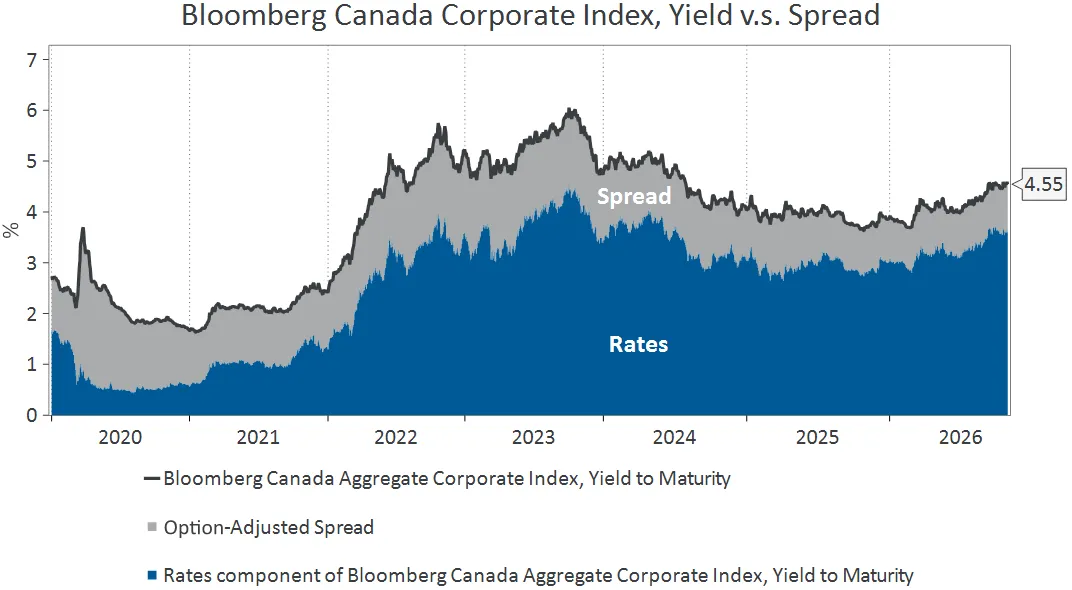
Corporate bond yields have two broad components: the yield on the underlying government curve and the credit spread that compensates investors for issuer, liquidity and structural risks. As shown in Figure 3, much of today’s yield comes from the government interest rate component, not the credit spread component.
A bond can therefore offer an appealing all-in yield without providing generous compensation for incremental credit risk. Investors are less well compensated for deteriorating fundamentals, refinancing risk or reduced liquidity. With less spread compensation available, the margin for error is smaller. This puts greater emphasis on security selection and bottom-up credit research. We believe that in this type of environment, avoiding a downgrade or a poorly structured security can be just as valuable as capturing additional yield.
Limited yield differentiation can also create relative value opportunities. For example, hybrid securities issued by established companies such as Enbridge and Rogers may offer yields comparable to those of smaller high yield issuers or more speculative special purpose structures. Although hybrids carry subordination risk, the underlying issuer’s credit quality may offer a more attractive risk-reward profile than other securities with a similar headline yield.
Figure 3. Decomposing Canadian corporate bond yields: Bloomberg Canada Aggregate Corporate Index yield from 2019 to October 2026, divided into rates and credit spread components. The yield ends at 4.46%, with approximately 80% coming from rates and 20% from credit spread.
Sources: Beutel, Goodman & Company Ltd., Bloomberg, as of 2026-10-30
Navigating Fixed Income: Active Management Along the Yield Curve
A structurally higher and more uncertain inflation environment is likely to produce greater volatility across the yield curve. At the front end, yields may remain particularly sensitive to evolving expectations for central bank policy. Further along the curve, we expect longer-term forces such as government borrowing requirements, inflation uncertainty and term premiums to play a greater role. These forces will not necessarily move in tandem, creating different risks and opportunities across maturities.
Currently, we see opportunities in the front end of the Canadian curve, where substantial additional tightening is already reflected in market pricing. Short-to-intermediate yields could decline if growth or inflation falls short of the conditions required to deliver the full tightening cycle. In contrast, we remain more neutral at the long end. Longer-maturity yields are closely tied to global bond markets, where elevated fiscal borrowing, inflation uncertainty and concerns about central bank credibility could keep term premiums under upward pressure.
The decision, therefore, is not simply whether to own bonds, but where along the yield curve investors are adequately compensated for taking interest rate risk, given evolving economic conditions, policy expectations and relative value evolve.
The Path Ahead
Fixed income’s journey home does not mean that bond markets have returned to calm seas. If anything, the post-Financial Repression environment may bring more frequent changes in inflation expectations, policy pricing and the shape of the yield curve.
What has changed is the starting point. Bond yields once again provide attractive income, which can help cushion the impact of future potential yield volatility.
The opportunity, however, is not uniform. In periods of heightened uncertainty, curve positioning and credit selection can be important drivers of fixed income returns. Navigating the new regime will therefore require active management, investment discipline and the flexibility to respond as relative value changes.
Download PDF
Related Topics and Links of Interest:
©2026 Beutel, Goodman & Company Ltd. Do not sell or modify this document without the prior written consent of Beutel, Goodman & Company Ltd. This commentary represents the views of Beutel, Goodman & Company Ltd. as at the date indicated. This document is not intended, and should not be relied upon, to provide legal, financial, accounting, tax, investment or other advice.
Certain portions of this report may contain forward-looking statements. Forward-looking statements include statements that are predictive in nature, that depend upon or refer to future events or conditions, or that include words such as “expects”, “anticipates”, “intends”, “plans”, “believes”, “estimates” and other similar forward-looking expressions. In addition, any statement that may be made concerning future performance, strategies or prospects, and possible future action, is also forward-looking statement. Forward-looking statements are based on current expectations and forecasts about future events and are inherently subject to, among other things, risks, uncertainties and assumptions which could cause actual events, results, performance or prospects to be incorrect or to differ materially from those expressed in, or implied by, these forward-looking statements.
These risks, uncertainties and assumptions include, but are not limited to, general economic, political and market factors, domestic and international, interest and foreign exchange rates, equity and capital markets, business competition, technological change, changes in government regulations, unexpected judicial or regulatory proceedings, and catastrophic events. This list of important factors is not exhaustive. Please consider these and other factors carefully before making any investment decisions and avoid placing undue reliance on forward-looking statements Beutel Goodman has no specific intention of updating any forward-looking statements whether as a result of new information, future events or otherwise.


