



11 August 2026
by Beutel Goodman Fixed Income Team
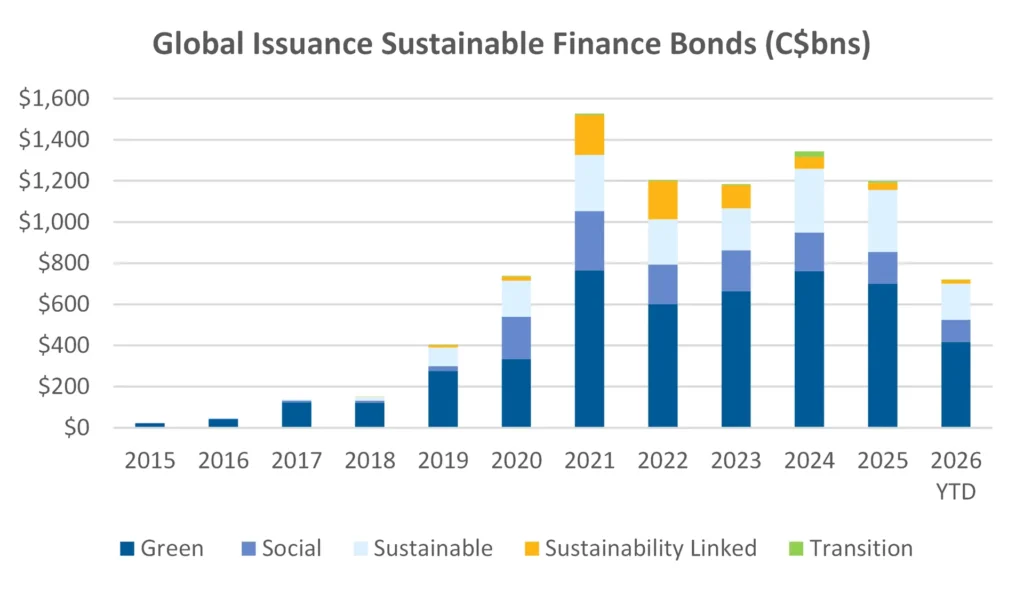
Source: Bloomberg LLP, as of June 30, 2026.
Sustainable finance issuance (including green, social, sustainable, sustainability-linked and transition bonds) totaled C$725 billion in the first half of 2026. This represents a 2% increase from C$714 billion in H1/25 and puts issuance on track to surpass 2025’s total of C$1.2 trillion. A milestone was reached in May 2026 as cumulative labelled bond issuance topped US$7 trillion (C$9.6 trillion). Green bonds remained the dominant segment, accounting for 58%, followed by sustainable bonds at 25%, social bonds at 15% and Sustainability-linked Bonds (SLBs) at 2%.
Quasi-sovereign issuers represented the largest share of issuance at 56%, followed by corporate issuers (33%), sovereign (8%) and securitized (3%). Europe continued to lead global activity, with France and Germany ranking as the largest issuing markets, while China rounded out the top three. The U.S. contributed only a modest share of global issuance. Europe remains a bright spot for sustainable finance, supported by increasing adoption of the European Green Bond (EuGB) standard. Consistent with recent periods, sovereigns, financial institutions and utilities remained active issuers.
Transition
Transition bond issuance continues to make up a very small part of the market at 0.01% but we expect that it will grow significantly over the next several years. The transition label suffers in part due to different definitions of transition as well as differing sustainable investor sentiment regarding the ability of brown companies to issue green bonds. Further issuance of transition bonds will likely be helped by the publication of Climate Transition Bond Guidelines by the International Capital Market Association and the continued development of sovereign sustainable finance taxonomies. Currently, there are approximately 60 national and regional taxonomies in use or in development, including in Canada.
The largest issuer of transition bonds currently is the Japanese government, having issued JPY 4.45 trillion (~$38.4 billion CAD) climate transition bonds since 2024. Proceeds from the bonds support the Japanese Government’s Green Transformation Program that aims to invest JPY 150 trillion to support decarbonization. The government’s climate transition framework has also enabled Japanese corporates in hard-to-abate sectors such as transportation to issue climate transition bonds.
Climate Resilience Bonds
In June 2026, the Climate Bonds Initiative issued an updated Climate Bonds Resilience Taxonomy. Changes in weather patterns and extreme climate events (e.g., wildfires, droughts, storms) bring physical risk to the forefront. The taxonomy outlines two types of investments: adapting and enabling. Adapting activities make an investment climate resilient thereby reducing material physical risk. Enabling activities help support the climate resilience of other investments and assets such as the manufacturing of leak detection systems. The first climate resilience bond was issued by the Tokyo Metropolitan Government. Proceeds from the bond issuance will finance projects that will enhance the city’s capacity to withstand climate-related risks including floods, storm surges and typhoons.
Canada
Canadian labelled debt issuance declined by 26% to $12.1 billion in H1/26 versus the first half of 2025, mainly attributable to some large issues by the Government of Canada ($3.5 billion) and the province of Ontario ($2.25 billion) in H1/25. The 2026 time period was highlighted by a new entrant that completed the largest corporate green bond issuance ever in the Canadian dollar market. Projet REM raised C$1.85 billion through green bond offerings across 5-, 7-, 10- and 30-year maturities, marking its inaugural transaction. Projet REM operates the Réseau express métropolitain (REM), a fully automated light-rail network serving the Greater Montréal region. Also of note, the City of Toronto issued its first sustainable bond under its new framework. Previously the municipality had issued green and social bonds under separate frameworks. Sectors targeted for the use of proceeds include environmental stability and climate action, housing, equity and social infrastructure, sustainable transportation and community safety and well-being.
During the first half of the year, the province of Ontario announced its intention to issue a $500 million Resilience Bond to fund defence projects through an Ontario Sustainable Bond Framework. The announcement was intended to bolster the province’s chances to host the new Defence, Security and Resilience Bank. Defence is a prickly subject for sustainable investors. Our sustainable bond strategies exclude companies who derive any revenue from conventional and controversial weapons. We do not support defence being considered a sustainable theme although we have no issues with defence standing on its own as a thematic strategy outside sustainability as is occurring in Europe.
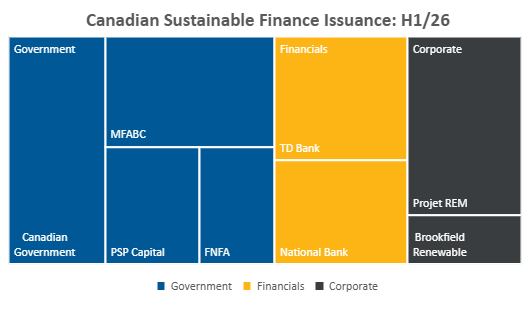
Source: Bloomberg LLP, as of June 30, 2026.
Outside of Projet REM, there has been a lack of new entrants to the Canadian sustainable debt market. The lack of a greenium[1] and heightened concerns around potential greenwashing appear to be keeping many prospective issuers on the sidelines. To ensure a robust labelled debt market in Canada we will need to find ways to entice new issuers. This may lead to some investors rethinking their approach on asking for no greeniums.
United States
U.S. labelled debt issuance increased significantly (C$16.9 billion in H1/26 versus C$12.5 billion in H1/25) mainly attributable to securitized green bonds issued by data centres which totaled C$11 billion in the first half of the year. The green use of proceeds from the ABS and CMBS data centre issues are generally focused on power and water use efficiencies. There has been some debate in the sustainable finance space as to whether data centres truly qualify as “green”. The argument centres around the fact that efficiency does not necessarily equate to sustainability. Even efficient data centres require significant amounts of power stressing power grids and there are concerns around water scarcity especially in some regions.
Also of note in the U.S., water technology company Xylem issued US$500 million of 10-year blue bonds, representing the first blue bond issuance by a U.S. corporate issuer. Issued under the company’s Blue and Green Financing Framework, proceeds are slated for eligible water-related investments aimed at enhancing water security, resilience and access to sanitation services.
Use of Proceeds
We track the use of proceeds from the labelled bond issuance. Although an issuing entity’s frameworks may identify multiple possible use of proceeds sectors and align with several UN Social Development Goals, it is important to understand how the monies are actually being allocated. For the first half of 2026, the top four categories for use of proceeds from global issuance were renewable energy (19%), access to essential services (15%), clean transportation (8%) and affordable basic infrastructure (8%).[2]
Greenium
The average greenium during the first half of the year was a skinny 1 basis point, although the range was wide.[3] Greeniums have settled in the 2 to 4 basis point range over the past several years. In general, new labelled bond issuers tend to attract a larger greenium which fades with subsequent labelled bond issuances. Scarcity also plays a role as larger greeniums appear to be tolerated for sustainable issuers who are not frequently in the market. Issuers require a greenium as an incentive to issue labelled bonds to help offset the increased costs of developing a framework, paying for a second party opinion and producing an impact report. The counterargument is that even without a greenium, there is an advantage to the issuer including smaller new issue concessions, stronger investor demand and stickier investor base. Labelled bonds also provide an opportunity for companies to showcase their projects that align with green and social outcomes. Investors are often reluctant to accept large greeniums, as they diminish the return potential of green bond investments relative to comparable conventional bonds. We are not opposed to a small greenium (1-2 basis points) but we believe that the company must earn it.
Canadian Taxonomy
In July 2026, Business Future Pathways released the Canadian Sustainable Finance Taxonomy: Methodology Report that is open for public comment. The Canadian taxonomy is intended to be a voluntary tool used to identify opportunities for climate-aligned investment in Canada that will help drive the country’s clean growth and decarbonization priorities. The framework considers three categories of eligible economic activities: Green, Transition and Abatement. The abatement sector has not been previously tackled in other taxonomies and is likely the most controversial in terms of stakeholders’ opinions. Both the green and transition categories map to the Paris-aligned pathway to a net zero future. The abatement sector tackles emissions-intensive industries that are unable to achieve the lifecycle GHG (greenhouse gas) emissions reductions that align with a Paris pathway; however, there may be select investments that may meaningfully reduce emissions in the short- and medium-terms. Carbon capture and storage in the oil and gas industry is an example of an abatement activity.
We believe that the draft taxonomy is attempting to be reflective of the Canadian economy whereby the energy sector contributes to approximately 27% of goods-producing GDP[4], and oil and gas extraction makes up approximately 30% of Canada’s total industrial GHG emissions.[5] Stakeholders will likely be divided on the use of abatement as a category. Investors that adhere to a science-based net-zero emissions pathway to 2050 typically seek to avoid financing activities that are inconsistent with that trajectory, including many oil and gas projects. However, for a taxonomy to be relevant and investable in Canada, it must accommodate sectors that account for approximately 30% of economic activity. We believe the abatement category seeks to address this reality while supporting decarbonization objectives. One of the many other questions that will need to be tackled as the taxonomy moves forward is what role natural gas generation, nuclear power and LNG export facilities will play in the taxonomy.
The Canadian taxonomy will also develop Do No Significant Harm and Minimum Social Safeguards. These standards ensure that climate mitigation objectives do not adversely impact other environmental and social values, or legal rights. For example, the impact on the employment and economic well-being of a community from the shuttering of a coal-fired generating station. Similar to the Australian and New Zealand taxonomies, part of the Minimum Social Safeguards includes Indigenous rights. This is imperative given the impact many economic activities have on Indigenous rights holders and reflecting that Canada has legislated the United Nations Declaration of the Rights of Indigenous Peoples.
Work on the final taxonomy as well as technical screening criteria for the six priority sectors (electricity, buildings, transportation, mining, manufacturing and agriculture and forestry) will be completed by year-end 2027. The Government of Canada plans to issue a new transition bond framework shortly thereafter. We believe that Canada has the opportunity to lead in the development of transition and abatement finance.
Indigenous Finance
While the issuance of Indigenous bonds was slow during the first half of the year outside of a $300 million 5-year issue from the First Nations Finance Authority, we still believe that Indigenous finance will emerge as an asset class. There were some positive developments in the first half of the year that could help solidify our view. The British Colombia government launched an Indigenous loan guarantee program joining Ontario, Alberta, Saskatchewan and Canada. Enbridge Inc. exchanged all the debt of Enbridge Pipelines for holdco debt. Enbridge Pipelines owns the Canadian portion of the Mainline pipeline. Easing the structural complexity clears the way for Enbridge to sell a minority interest in the pipeline to Indigenous communities. The two proposed crude oil pipelines, one to the west coast and one to Sarnia refineries in the east, will cross Indigenous lands and likely involve equity ownership. Securing Free, Prior and Informed Consent amidst a fast-tracked approval process will also be a key focus point of these pipeline proposals. Other projects that could involve Indigenous financing include:
- The Williams Treaties First Nations will invest $700 million in Ontario Power Generation’s Darlington New Nuclear Project (SMR).
- Hydro-Québec announced a financing program exceeding $5 billion for major wind energy projects involving Indigenous communities.
- A group of BC First Nations have the option to acquire a majority ownership in LNG Canada’s new storage tank infrastructure for $1 billion.
- The Indigenous-led partners for the $20 billion Ksi Lisims LNG project are targeting a final investment decision by year-end 2026.
- Hydro One and seven First Nations are developing the Greenstone Transmission Line connecting existing infrastructure in Nipigon Bay to the Aroland First Nation.
- Manitoba Hydro will consider up to 11 proposals to build new wind farms over the next nine years, all owned by partnerships between Indigenous nations and wind power developers.
Conclusion
The labelled bond market continues to grow despite headwinds to responsible investing. We believe that the issuance of core green and social bonds will be complemented by emerging sustainable asset classes such as blue bonds, transition bonds, climate resilience bonds and Indigenous finance.
[1] A greenium or green premium is the yield advantage that a green bond enjoys relative to a comparable conventional bond from the same issuer.
[2] “Sustainable Debt Monthly June 2026: Summer Pause”, BloombergNEF, July 17, 2026.
[3] IBID.
[4] Statistics Canada, June 30, 2026 https://www150.statcan.gc.ca/t1/tbl1/en/tv.action?pid=3610043403
[5] Statistics Canada, 2023 https://www150.statcan.gc.ca/t1/tbl1/en/tv.action?pid=3810009701
Download PDF
Related Topics and Links of Interest:
©2026 Beutel, Goodman & Company Ltd. Do not sell or modify this document without the prior written consent of Beutel, Goodman & Company Ltd. This commentary represents the views of Beutel, Goodman & Company Ltd. as at the date indicated. This document is not intended, and should not be relied upon, to provide legal, financial, accounting, tax, investment or other advice.
Certain portions of this report may contain forward-looking statements. Forward-looking statements include statements that are predictive in nature, that depend upon or refer to future events or conditions, or that include words such as “expects”, “anticipates”, “intends”, “plans”, “believes”, “estimates” and other similar forward-looking expressions. In addition, any statement that may be made concerning future performance, strategies or prospects, and possible future action, is also forward-looking statement. Forward-looking statements are based on current expectations and forecasts about future events and are inherently subject to, among other things, risks, uncertainties and assumptions which could cause actual events, results, performance or prospects to be incorrect or to differ materially from those expressed in, or implied by, these forward-looking statements.
These risks, uncertainties and assumptions include, but are not limited to, general economic, political and market factors, domestic and international, interest and foreign exchange rates, equity and capital markets, business competition, technological change, changes in government regulations, unexpected judicial or regulatory proceedings, and catastrophic events. This list of important factors is not exhaustive. Please consider these and other factors carefully before making any investment decisions and avoid placing undue reliance on forward-looking statements Beutel Goodman has no specific intention of updating any forward-looking statements whether as a result of new information, future events or otherwise.


